

Subtle human energy design across the world
First published in Energy magazine, this cross-cultural analysis of human energy anatomy discusses how as one people, our design is key to balance, health, and peace.

It seems each civilization was entrusted with one aspect of the human subtle energy picture. Perhaps the information was segmented and shrouded in mystique because to understand, and cultivate, subtle energy is to cultivate a higher frequency life—in every dimension and density. And that, well, that is power.
Despite my enthusiasm, I am careful to only introduce a few basic terms to new clients. Many are seeking immediate pain relief and don’t have the focus to try to piece together the subtle system without diagrams. Even then, it’s like riding a bicycle. You don’t need to know all the parts for it to work, or to take it to someone else to assist with straightening out the frame after a bumpy road. Still, as a practitioner and teacher, I sketch what I believe is the bare minimum a newbie should understand: energy, the chakras, the meridians/nadis, and the biofield. I trust as they open to learn more, they will ask.
Personally, I’m always open to gather knowledge seemingly strewn far and wide, to listen to how different teachers infer the information and experiences, and to see what metaphors and literalisms are applied to help people create and maintain balanced, healthy existences and communities. As my understanding of the subtle energy human and global anatomy has expanded, it has impacted my intentions while guiding energy sessions as well as in my daily existence.
First the human energy anatomy terminology:
From the Taoist tradition and Chinese, we find early meditation practices dating from circa 400 BCE noting lower abdomen involvement. However, the term “Lower Dantian” as the ‘elixir-of-life field” or the location of regeneration and vital energy storage did not surface until approximately the third century CE in the Laozi Zhongjing. Today, energy practitioners such as Amanda Vogler, teach how the three Dantiens (lower, middle, and upper) and the Hara Line provide the initial subtle energy construction around which chakras, meridians, nadis, the biofield, and dense anatomical body develop.
In Sanskrit, chakra means “spinning wheel of light.” That connection to light shows up in many spiritual traditions. The term’s earliest use seems to arise from the 11th century Kaula Hindu manuscript. Most energy practitioners in the U.S. work with seven chakras, or power centers, which collect, filter, and transition energy levels into or out of the body, as well as up the trunk of the human body.
These are seven of the 114 chakras recognized in the Indian health view. Dr. Amit Ray teaches there are an additional 21 minor chakras (like the palms, feet, and various joints) as well as 86 micro chakras. He teaches there are 108 that reside within the body and six that reside outside of the body extending into the auric field. He also teaches that there are 72,000 nadis (pathways/channels) for information collection and dissemination, purification, and energy distribution across planes as they are part of the causal body as well as the astral body.
Three major nadis move energy up the core: Ida (left side and associated with parasympathetic nervous system), Pingala (right side and associated with sympathetic nervous system), and Sushumna (center channel associated with spine). This creates the classic medicine icon—the staff (spine) with two snakes (Ida and Pingala energy nadis) connecting the main chakras up to divine connection—enlightenment or Divine frequency--at the top of the staff.
In Chinese Traditional Medicine, acupoints are special entry points on meridians. Acupressure and acupuncture, with or without electrification, are used to stimulate subtle energy flow in the body and release blocks for improved total health. A 2021 Chinese published research study, “In Vivo Visualization of the PIericardium Meridian with Fluorescent Dyes” substantiates earlier studies that acupoints do connect with meridians and “did not reveal any corresponding vessels (arterial or venous) at the visualized tracer pathway but did demonstrate correlations with intermuscular fascia.” Thus, the webbing structure of nadis and meridian pathways act as both information scouting pathways, as well as energy byways as part of the connective tissue fascia system.
To understand the importance of fascia, consider John Hopkins University’s description: “connective tissue that surrounds and holds every organ, blood vessel, bone, nerve fiber and muscle in place. The tissue does more than provide internal structure; fascia has nerves that make it almost as sensitive as skin.” It holds everything in place, connects to all with its own messaging nervous system, and is capable of reacting to distress. It is a body system that warrants more respect.
Edging to the Middle East, in Islam, there is not wide agreement about subtle energy; however, recent studies of sacred scriptures and Sufi mysticism have revealed interpretations of energy, light, and similar subtle energy terminology. In Arabic, universal energy flow is called “Qudra”—the human body’s light. It was recorded as visible and oft referenced by the Prophet Muhummed when he asked Allah to bring the light into his body.
In one article, “The Lataif of Islam,” the concept of light power centers is explored. Explained as “similar to acupuncture points” in one place and similar to chakras in another, their purpose is healing the body and bringing the heart closer to divinity. The heart Lataif, is positioned in the same place as the Indian heart chakra but has four supporting chambers or power centers. A total of nine centers are believed to be in the chest area in total.
The Lataif are part of the light body, or energy body, and in the centers, light is taken in as well as emitted. Another source identifies power centers in the following areas: Akhfa is in the same location as the crown chakra. Khafi is in the brow chakra location. Sirr is known as the ultimate secret or bridge between the physical and metaphysical and is in the heart chakra location. Rooh, the soul, and Qalb, seat of personality, emotions, and intentions, are slightly under and to the left and right of Sirr. The Nafs resides approximately in the Sacral and Solar Plexus regions.
In the western world, the Aztec/Nahua/ Ōmeteōtl perspective incorporates the idea of a dual cosmic energy or sacred life force in the universe. Various indigenous of the Americas recognize the need for balance with the energetic life force of Turtle Island, the stars, the ancestors, the community, and within one’s spirit. The belief extends to the extent that soul retrieval ceremonies are sometimes necessary to bring back parts of the energetic body that have been set aside, or cast off, during trauma. Though specific energy anatomy term are not part of their cultural tradition, the life force concept is long running. Call it energy, qi, ki, prana, life source, vitality, Qudra, or even the force: all refer to the same flow which imbues every aspect of life, nature, and the universe.
So as energetic designs, the balance of energetic flow and maintaining a healthy frequency or level of energy has been part of the cultivated wisdom. It should be no surprise that cultures across the world created moving meditations for their people to practice to subconsciously assist with balance—even if the general populations were not told what the movements would do for them. At minimum, they were passed off as dutiful ways to show spiritual and community adherence.
Moving Meditations for Energy Balance and Increasing Effective Frequencies
Through Healing Touch training, the self-chakra connection remains an effective go-to strategy. However, to assist our fascia, nadis, physical and subtle bodies, I’d encourage practitioners to work in a weekly or monthly full body moving meditation as well. Having explored yoga, Tai Chi, Salat, and other structured cultural movements, I can vouch for their ability to move energy, facilitate physical, emotional and spiritual releases, as well as assist the body’s healing toward effective homeostasis as well as heightened spiritual states.
The earliest mention of yoga principles for mind, body, and spirit energetic balance appeared in the “Upanishad” or last sections of the Veda (ca. 1300-900 BCE). Current yoga practices talk about the eight limbs (principles) of which the third is Asana (physical postures); these stretches increase energetic flow for health. Pranayama (breath control) is the accompanying fourth limb.
The ancient practice of dawn and twilight sun salutations is perhaps the most well-known asana combination. Four cycles of the sun salutation are common and, practitioner-writers Pandit Rajmani Tigunait and Sandra Anderson claim in an article for Yoga International, doing so “fans your digestive fire, energizes the nervous system, balances your pranic flow, activates both the lower and upper extremities, and influences your moods.”
The sun salutation postures include mountain/namaste, overhead stretch, standing forward fold, lunge, plank pose, eight-point pose, cobra pose, downward facing dog, lunge, standing forward fold, overhead stretch/mountain, and namaste.
Moving from India to the Middle East, in Islam, the Salat/Salah moving prayer, is the second of five main pillars of the Muslim faith. The Qur’an/Koran—believed to have been written by Muhammad’s scribes shortly after his death in 632 AD—establishes the practice of praying at five specific hours of the day. The prayer sequences vary only in the number of repeated cycles, or Ra’kahs. Each Ra’kah unit is comprised of seven to nine postures. Analysis of Salat ul-Fajr, the early morning prayer flow, shows the postures involved: Takbir, Qayyam, Ruku, Qayyam, Sajdah/Sujud/Sujood, Jalsa/Tashahhud, Sajjdah/Sujud/Sujood, Jalsa/Tashahhud, and Salam.
Interestingly, the similarity between Salat and yoga forms has been noted by the international research community and now multiple studies have found similar health benefits—enough to give rise to the term “Islamic yoga” by members of the Islamic community. Several Muslim-authored articles are advancing the idea that practicing Salat, even without the prayers, will provide similar physical health benefits for any practitioner and should be considered as a viable physical fitness routine akin to Yoga or Pilates for anyone around the world.
The chart shows some similar positions between the two practices.
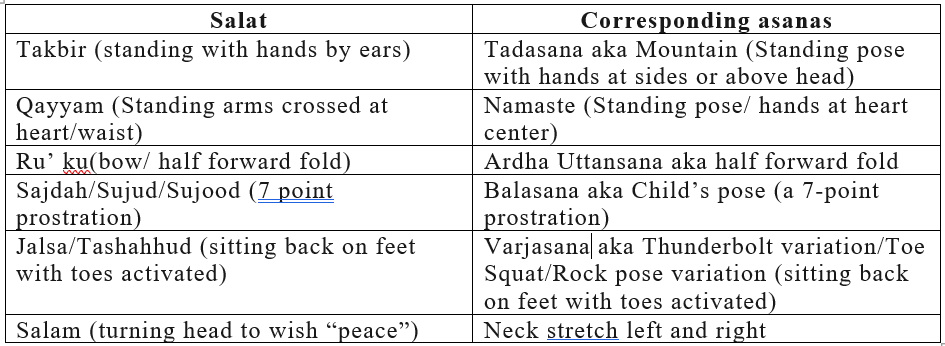
Though there is some disagreement among Muslims about the existence of the subtle energy anatomy (chakras, nadis, etc.), researchers in the community have published about the impact of Salat on the energy anatomy. Raof Ahmad Bhat, author of “Unity of Health through Yoga and Islamic Prayer ‘Salah’” in 2014, summarized, “positions together activate all seven chakras in the body as per yoga practices….Sujud is said to activate the crown chakra….Its healthy function balances one’s interior and exterior energies.”
Sufi Muslim mystic poet Jalaluddin Rumi of the 13th century is said to have begun the “Whirling Dervish Ceremony.” It involves focused chanting and intentional spinning. He would fast, meditate, and then dance to reach a state of unparalleled enlightenment. By the 15th century, the Sufi order had established rules for the ritual which had come to be called “Sema.”
Per a video of a demonstration done at the Galata Mevlivihanesi Muzesi in Turkey, the ritual begins as a leader brings a prayer mat into the circle. Each dancer performs a Ru’ku (half forward fold) at the entrance to the dance arena. When the dancers are in line at the side, the leader performs Sujud toward the high balcony. The others alternately offer additional Ru’kus to the center and bows to each other, then crossing arms across their chests, they take places around the room.
One arm is held high in another world and another held low in this world. They start to turn [counter-clock-wise as the earth spins] in rhythmic patterns, using the left foot to propel their bodies around the right foot with their eyes open, but unfocused. With each turn, he or she says silently, “Allah, Allah.” The dervishes orbit one another, recreating the movement of the heavens.” It is both, at once, grounding and expanding of the individual physically, energetically, and spiritually.
According to Nurhan Atasoy in her book Dervis Ceyizi , “Dancers wear long white robes with full skirts. On the dancers’ heads sit tall conical felt hats called sikke. As the dancers turn, the skirts of their robes rise, becoming circular cones, as if standing in the air on their own volition. A team of researchers found that the edges of spinning skirts experience accelerations of about four times Earth gravity, reporting that the skirts “carry cusped wave patterns which seem to defy gravity and common sense.” This energy lift, or vortex, could be explored in an essay of its own.
Energetic Aspects
The sacred geometry of circles has been utilized by different cultures for millenia. Many indigenous traditions hold that when an individual or a group moves in a circle, it generates energy. Round Dances or dancing in The Circle is part of traditional pow wows as well as organized teachings. Movement slow, or fast, in the circle, creates an energetic flow drawing all in the stream together and focusing the energy collectively into the center. Many folk traditions around the world also have dances done in rounds worthy of further contemplation.
Some workshops led by indigenous teachers may ask students to sit in a circle with a sacred altar or fire in the center. Protocols dictate how one may enter the circle. If the circle is led by a man, or is of mixed genders, one enters, acknowledges the altar, and then proceeds clockwise one full rotation before being seated. Per Abenaki custom, if the circle instruction is for women only and led by a woman, after the altar acknowledgement, the woman moves counter-clockwise one full rotation before taking her seat.
Counter-clockwise is considered the feminine energy and clock-wise male energy. Similar to the yin and yang energy concept, gender energy is part of indigenous tradition. Additionally, Abenaki women’s teaching, advocate women to wear long skirts so that as one moves and walks, the circular hem guides the earth’s energy up the frame to support the person’s connection and health.
Flow and circular movements are also found in the moving meditations of Tai Chi and Qi Gong of Taoism precepts. Termed the philosophy of “the people,” Taoism is said to have developed from various religious and philosophical traditions (like shamanism and nature religions) in ancient China as far back as the 4th century BCE. The main emphasis is living in harmony with Tao, or The Way—the source and substance of all that exists.
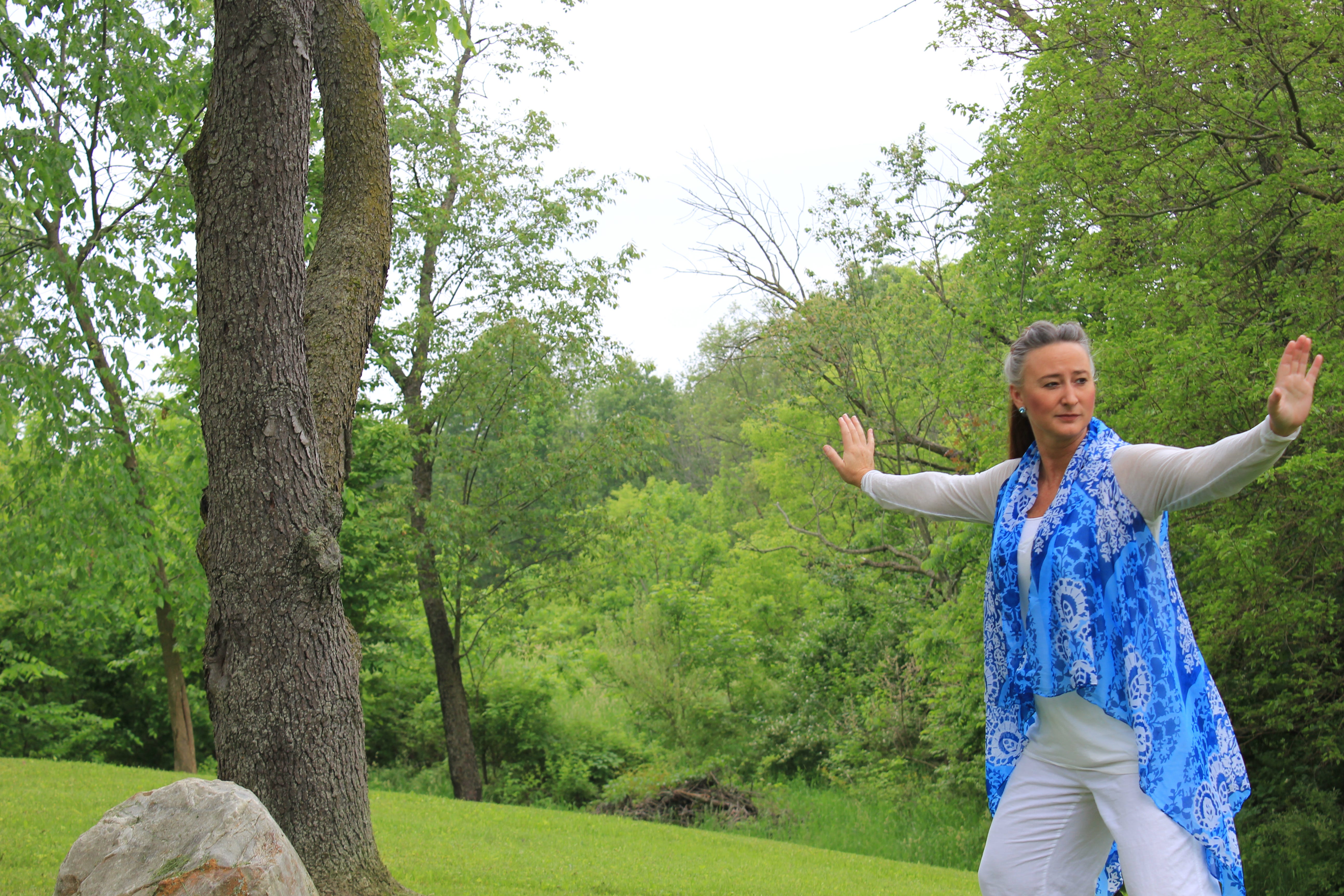
Qi Gong and Tai Chi are the two most widely known Chinese moving meditations and are both part of a traditional Chinese health regimen and martial arts training. Sources disagree on the actual earliest origin of Qi Gong. Some advocate its elements are present in the Huangdi Neijing book of internal medicine which claims its authorship falls between 400 BCE and 220 CE. The Taoist Sanctuary proposes Qi Gong originated in dances of early Wu shaman to induce trance states for communicating with the spirit world. Later it is hypothesized Hua To’s “Frolic of the Five Animals” synthesized the Chinese Medicine Theory of Channels (meridians) and the “Three Burning Spaces” (today called the Dantiens).
Energy & Spiritual Aspects
“Qi,” in Chinese, translates to breath/spirit/energy. “Qi Gong” is breath/energy work. There are both passive and active practices incorporating exercise postures and breath work. Tai Chi is one of the traditional martial arts in China. It is named after a philosophy term meaning, “in all changes exists Tai Chi, which causes the two opposites in everything.”
Tai Chi is sometimes described as the moving form of Qi Gong. Whereas yoga asanas are done to prepare for meditation, Qi Gong is often done to prepare for Tai Chi. The eight brocades are a series of active Qi Gong exercises: each one focuses upon clearing a different energy meridian in the body. Tai Chi, on the other hand, is a continuous flow that works the entire body. Regardless of if you are doing a moving form of Qi Gong, or Tai Chi, the goal is to sink one’s Qi from the Dantien into the earth for connective, shared flow.
Slightly similar to Dervish Whirling, Wild Goose Qi Gong uses circular and spiral movements. It is meant to be a fluid, nearly effortless continuous movement. With dance-like movements, it is meant to foster peace, relaxation, and joyful meditation while activating the acupoints of the feet to assist energy flow through the major meridian paths.
Comparing its flows to other cultures’ postures has limited value. However, Yoga’s Tree is similar to Marching pose as a Tai Chi warm up. Standing Palm Tree and Forward Fold can be seen in Wild Goose’s 64 movements. Tai Chi, Form 13 (Kick with Heel) is similar to Utthita Hasta Padangusthasana. Additional forms incorporate similar moves to yoga such as Lunges, Goddess pose, and Warrior I. Others have also compared Mountain pose with Qayuum in Islam Salat and “Return to the Mountain” in Tai Chi. Thus, we would expect similar physical benefits across platforms.
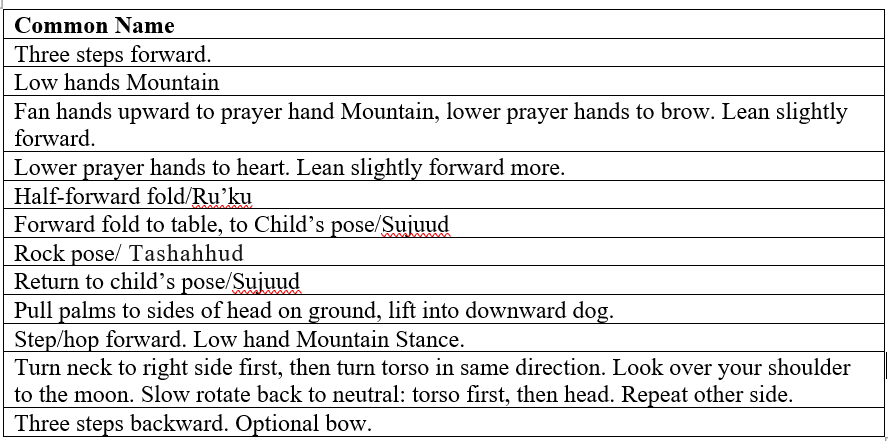
If you’d like to reap the benefits of a physical flow not based on one of the world’s religions, consider the flow I synthesized below pulling from Jewish, Hindu, Islamic, and Chinese traditions.
May your light body shine strong, be steady in flow, and of a frequency that draws only the highest and greatest good to you and yours. Peace.